Prof. Dr. Esim Gürsoy
BIODATA: Prof. Dr. Esim Gürsoy is a teacher trainer at the ELT Department of Bursa Uludağ University, Türkiye. She holds an M.A. in teacher education and a TESOL certificate from Ohio University, USA and a Ph.D in English Language Teaching from Anadolu University, Türkiye. Her research interests include, teaching English to young learners, social emotional learning, mindfulness practices in ELT, language teacher education, and integrating socially responsible teaching to ELT.
Speech Title: Integrating Social-Emotional Learning into EFL Classrooms
This presentation focuses on the integration of Social-Emotional Learning (SEL) into English as a Foreign Language (EFL) classrooms and discusses how social and emotional competencies support both academic and personal development. The presentation introduces the theoretical foundations of SEL and explains its five core competencies: self-awareness, self-management, social awareness, relationship skills, and responsible decision-making. It further examines why SEL has gained importance in educational settings by highlighting its contribution to academic achievement, well-being, resilience, empathy, communication, and positive classroom relationships. In addition, the presentation provides practical classroom applications and activity examples such as emotion check-ins, gratitude lists, mindful breathing, journaling, class circles, growth circles, and reflective discussions that can be integrated into language teaching contexts. Emphasizing the role of emotions in learning, the presentation argues that emotionally supportive classroom environments can enhance student engagement, intercultural understanding, collaboration, and overall learning outcomes in EFL classrooms.
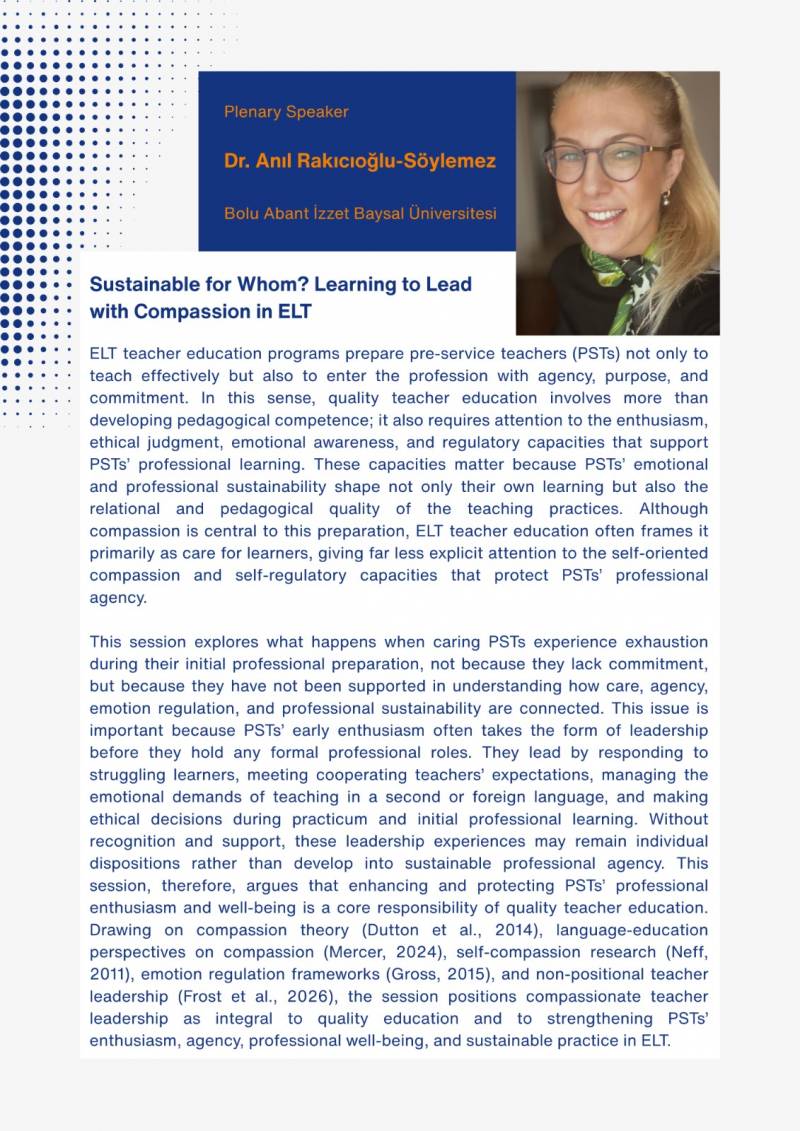
Prof. Dr. Anıl Rakıcıoğlu Söylemez
BIODATA: Anıl Rakıcıoğlu-Söylemez is a professor of English Language Teaching at Bolu Abant İzzet Baysal University in Türkiye. She holds a PhD in English Language Education from Middle East Technical University. She teaches courses on teacher education, language teaching methodology, second language acquisition, and the psychology of language learning and teaching at both undergraduate and graduate levels. Her research interests include pre-service teacher education and the psychological dimensions of language learning and teaching, including motivation, identity, beliefs, and emotions.
Speech Title: Sustainable for Whom? Learning to Lead with Compassion in ELT
ELT teacher education programs prepare pre-service teachers (PSTs) not only to teach effectively but also to enter the profession with agency, purpose, and commitment. In this sense, quality teacher education involves more than developing pedagogical competence; it also requires attention to the enthusiasm, ethical judgment, emotional awareness, and regulatory capacities that support PSTs' professional learning. These capacities matter because PSTs' emotional and professional sustainability shape not only their own learning but also the relational and pedagogical quality of the teaching practices. Although compassion is central to this preparation, ELT teacher education often frames it primarily as care for learners, giving far less explicit attention to the self-oriented compassion and self-regulatory capacities that protect PSTs' professional agency.
This session explores what happens when caring PSTs experience exhaustion during their initial professional preparation, not because they lack commitment, but because they have not been supported in understanding how care, agency, emotion regulation, and professional sustainability are connected. This issue is important because PSTs' early enthusiasm often takes the form of leadership before they hold any formal professional roles. They lead by responding to struggling learners, meeting cooperating teachers' expectations, managing the emotional demands of teaching in a second or foreign language, and making ethical decisions during practicum and initial professional learning. Without recognition and support, these leadership experiences may remain individual dispositions rather than develop into sustainable professional agency. This session, therefore, argues that enhancing and protecting PSTs' professional enthusiasm and well-being is a core responsibility of quality teacher education. Drawing on compassion theory (Dutton et al., 2014), language-education perspectives on compassion (Mercer, 2024), self-compassion research (Neff, 2011), emotion regulation frameworks (Gross, 2015), and non-positional teacher leadership (Frost et al., 2026), the session positions compassionate teacher leadership as integral to quality education and to strengthening PSTs' enthusiasm, agency, professional well-being, and sustainable practice in ELT.
Asst. Prof. Dr. Rizwan Ul-Huq
BIODATA: Rizwan-ul Huq is an Assistant Professor in the English Language Teaching (ELT) section at Sakarya University. He received his PhD in Educational Practice from Linköping University, Sweden, in 2021, where his research focused on English-medium schooling, language policy, and classroom interaction within EMI contexts. His research expertise lies in social interaction, multimodality, bilingual education, and English language teaching. His teaching interests encompass applied linguistics, general linguistics, and the adaptation of English literature for ELT purposes. He has contributed to international scholarly initiatives through conferences and panel organisations, including the British Association for Applied Linguistics (BAAL) and Sociolinguistics Symposium 24 in Ghent, Belgium, and has co-organised research events such as the Mid Sweden University Data Sessions for Social Interaction. His publications appear in international journals, addressing topics such as classroom interaction, translanguaging, and pedagogical practices in multilingual education. His current research explores multimodal pedagogy, gaming interaction, bilingual education, and social interaction in ELT contexts, alongside teaching interests in sociolinguistics, applied linguistics, general linguistics, and literature in ELT.
Speech Title: Evidence-Based Pedagogy: Bridging Theory and Classroom Practice in ELT
The gap between research and classroom practice remains a primary challenge in English Language Teaching (ELT). Evidence-Based Pedagogy offers a critical bridge, connecting empirical findings from Applied Linguistics and second language acquisition (SLA) research with the practical realities of the classroom. By utilising evidence as a framework rather than a rigid set of prescriptions, practitioners can adapt insights regarding language processing, corrective feedback, and task design to meet specific learner needs. Applications within Task-Based Language Teaching (TBLT), for instance, illustrate how research informs flexible, context-sensitive instruction. This approach positions teachers as reflective designers who make pedagogical decisions that are transparent, evidence-grounded, and responsive to dynamic classroom environments. In turn, classroom experiences shape research agendas, transforming teaching sites into sources of theory refinement and contextually grounded knowledge.
Keywords: ELT, research-practice gap, evidence-based teaching, adaptive instruction, principled eclecticism.
Çağdaş Yıldız
BIODATA: Çağdaş is a teacher trainer and English teacher with over 9 years of experience in the field. He has a strong interest and background in educational technologies and has been a Google Certified Educator since 2023. Alongside his TESOL trainings, he continuously develops himself in the fields of AI integration and modern teaching methods. As a Wayground Certified Game Changer & AI Trainer, he actively promotes designing sessions that are dynamic, interactive, and learner-centered. He has delivered various workshops focusing on EdTech tools and contemporary ELT approaches, aiming to inspire teachers to embrace innovation in their classrooms. For him, every session is an opportunity to share his passion for teaching and learning.
Speech Title: Teach Forward: How AI Is Reshaping the Language Classroom and What We Can Do About It Today
Artificial intelligence is no longer a future concern for language educators. It is already shaping the classrooms pre-service teachers (PSTs) are preparing to enter. As AI tools become increasingly embedded in educational contexts, PSTs need more than technical familiarity; they need the professional vision to engage with these tools critically, intentionally, and with pedagogical purpose. This session argues that AI literacy, understood as the capacity to understand, evaluate, and thoughtfully apply AI in language teaching, is a core component of building sustainable, innovative, and excellent teaching practice.
Grounded in the AI Literacy framework, this session examines what it means for PSTs to move beyond surface-level tool use and develop genuine competence in working with AI across different stages of lesson design, learner feedback, and classroom interaction. Rather than framing AI as a disruptive force, the session repositions it as a pedagogical partner that can support differentiated instruction, meaningful feedback, and learner-centred design. Innovation in ELT does not mean replacing teacher judgment with algorithmic convenience; excellence lies in PSTs entering the profession as reflective, digitally fluent practitioners who use technology responsibly and purposefully. Through interactive demonstrations and practical task design, participants will leave with concrete tools and a clear first step toward integrating AI into their own teaching practice.